SEO Meta Title
Earthquake: Causes, Effects, Safety Tips, and Impact on Human Life
Learn everything about earthquakes, including their causes, types, effects, safety measures, and prevention awareness. A complete guide to understanding earthquakes and protecting yourself during natural disasters.
Focus Keywords
earthquake, earthquake causes, earthquake safety tips, effects of earthquake, natural disasters, earthquake preparedness, seismic waves, earthquake prevention, earthquake awareness
Earthquake: Understanding One of Nature’s Most Powerful Forces
Earthquakes are among the most destructive natural disasters on Earth. They can occur suddenly without any warning and have the potential to cause massive destruction to life, property, and the environment. Every year, thousands of earthquakes occur across the globe. While many are too small to be felt, some are powerful enough to destroy entire cities and leave lasting impacts on communities.
Understanding earthquakes is essential because they affect millions of people worldwide. By learning about their causes, effects, and safety measures, individuals and communities can better prepare themselves and reduce the risks associated with these natural events.
What is an Earthquake?
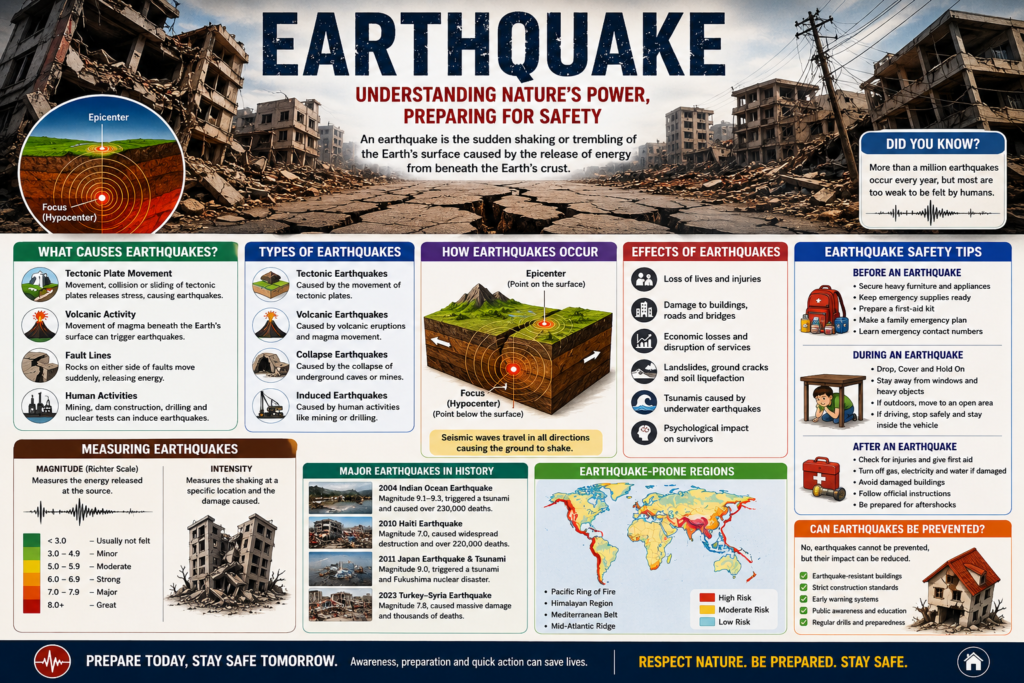
An earthquake is the sudden shaking or trembling of the Earth’s surface caused by the release of energy from beneath the Earth’s crust. This energy creates seismic waves that travel through the Earth and cause the ground to move.
The point inside the Earth where the earthquake originates is known as the focus or hypocenter, while the point directly above it on the Earth’s surface is called the epicenter. The intensity of shaking is usually strongest near the epicenter.
Earthquakes can last from a few seconds to several minutes, depending on their magnitude and depth. Even a brief earthquake can cause significant damage if it occurs in a densely populated area.
What Causes Earthquakes?
Earthquakes occur due to several natural and human-made reasons. Some of the major causes include:
1. Tectonic Plate Movement
The Earth’s outer layer is divided into large sections called tectonic plates. These plates constantly move, although very slowly. When two plates collide, separate, or slide past one another, stress builds up along their boundaries. When the accumulated stress becomes too great, it is released suddenly, resulting in an earthquake.
This is the most common cause of earthquakes worldwide.
2. Volcanic Activity
Volcanic eruptions can trigger earthquakes. As magma moves beneath the Earth’s surface, it creates pressure and fractures in surrounding rocks. These movements generate seismic activity known as volcanic earthquakes.
3. Fault Lines
A fault is a crack in the Earth’s crust where rocks on either side move relative to each other. Many earthquakes occur along fault lines when accumulated stress is released suddenly.
4. Human Activities
Certain human activities can also induce earthquakes. These include:
- Mining operations
- Large dam construction
- Underground nuclear testing
- Deep drilling activities
- Extraction of oil and natural gas
Although these earthquakes are generally smaller than natural ones, they can still cause damage in some areas.
Types of Earthquakes
Earthquakes can be classified into different types based on their causes.
Tectonic Earthquakes
These occur due to the movement of tectonic plates and are the most common and destructive type of earthquakes.
Volcanic Earthquakes
These are associated with volcanic eruptions and magma movement beneath the Earth’s surface.
Collapse Earthquakes
These occur when underground caves or mines collapse, causing localized shaking.
Induced Earthquakes
These result from human activities such as mining, drilling, and reservoir construction.
Measuring Earthquakes
Scientists use specialized instruments called seismographs to detect and measure earthquakes.
Magnitude
The magnitude measures the amount of energy released during an earthquake. The Richter Scale and Moment Magnitude Scale are commonly used for this purpose.
General classification includes:
- Below 3.0 – Usually not felt
- 3.0 to 4.9 – Minor earthquake
- 5.0 to 5.9 – Moderate earthquake
- 6.0 to 6.9 – Strong earthquake
- 7.0 to 7.9 – Major earthquake
- Above 8.0 – Great earthquake
Intensity
Intensity measures how strongly people feel the earthquake and the amount of damage caused in a particular location.
Effects of Earthquakes
Earthquakes can have devastating consequences for both humans and the environment.
1. Loss of Human Life
One of the most tragic effects of earthquakes is the loss of life. Building collapses, falling debris, landslides, and tsunamis can result in thousands of casualties.
2. Damage to Infrastructure
Earthquakes can destroy:
- Homes
- Schools
- Hospitals
- Roads
- Bridges
- Railways
- Airports
The repair and reconstruction process often requires significant time and financial resources.
3. Economic Losses
Businesses may be forced to shut down temporarily or permanently. Governments spend billions of dollars on rescue operations, rebuilding infrastructure, and supporting affected populations.
4. Environmental Damage
Earthquakes can alter landscapes by creating cracks in the ground, triggering landslides, and changing river paths.
5. Tsunamis
Underwater earthquakes can generate massive ocean waves known as tsunamis. These waves can travel thousands of kilometers and cause severe destruction along coastlines.
6. Psychological Impact
Survivors often experience anxiety, stress, depression, and trauma after a major earthquake. The emotional recovery process can take years.
Major Earthquakes in History
Several earthquakes have caused catastrophic damage throughout history.
2004 Indian Ocean Earthquake
One of the deadliest earthquakes ever recorded occurred on December 26, 2004. It triggered a massive tsunami that affected multiple countries and caused hundreds of thousands of deaths.
2010 Haiti Earthquake
A devastating earthquake struck Haiti, causing widespread destruction and leaving millions of people homeless.
2011 Japan Earthquake and Tsunami
Japan experienced a powerful earthquake followed by a tsunami. The disaster caused significant loss of life and led to the Fukushima nuclear accident.
2023 Turkey-Syria Earthquake
A major earthquake struck parts of Turkey and Syria, resulting in extensive damage and a large humanitarian crisis.
These events highlight the importance of earthquake preparedness and resilient infrastructure.
Earthquake-Prone Regions
Earthquakes can occur anywhere, but some regions are more vulnerable than others.
Pacific Ring of Fire
This region surrounds the Pacific Ocean and is responsible for a large percentage of the world’s earthquakes and volcanic activity.
Himalayan Region
Countries such as India, Nepal, Pakistan, and Bhutan experience frequent seismic activity due to the collision of tectonic plates.
California, USA
The San Andreas Fault makes California one of the most earthquake-prone regions in North America.
Japan
Located near several tectonic plate boundaries, Japan experiences thousands of earthquakes each year.
Earthquake Safety Measures
Being prepared can significantly reduce injuries and fatalities during an earthquake.
Before an Earthquake
- Secure heavy furniture and appliances.
- Keep emergency supplies ready.
- Prepare a first-aid kit.
- Store drinking water and non-perishable food.
- Create a family emergency plan.
- Learn emergency contact numbers.
During an Earthquake
If Indoors
- Drop to the ground.
- Take cover under a sturdy table or desk.
- Hold on until the shaking stops.
- Stay away from windows and glass objects.
If Outdoors
- Move to an open area.
- Stay away from buildings, trees, poles, and power lines.
If Driving
- Stop the vehicle safely.
- Avoid bridges and overpasses.
- Remain inside the vehicle until the shaking stops.
After an Earthquake
- Check for injuries.
- Provide first aid if necessary.
- Turn off gas and electricity if damaged.
- Avoid damaged buildings.
- Follow official emergency instructions.
- Be prepared for aftershocks.
Can Earthquakes Be Prevented?
Currently, earthquakes cannot be prevented. Scientists cannot stop tectonic plates from moving. However, their impact can be reduced through proper planning and preparedness.
Some effective measures include:
- Earthquake-resistant building designs
- Strict construction standards
- Public awareness programs
- Early warning systems
- Emergency response planning
- Regular disaster preparedness drills
Investing in these measures can save countless lives and reduce economic losses.
Importance of Earthquake Awareness
Education and awareness play a crucial role in disaster management. People who understand earthquake risks are more likely to respond effectively during emergencies.
Schools, colleges, workplaces, and local governments should conduct awareness campaigns and training programs. Communities that are well-prepared can recover more quickly and efficiently after a disaster.
Conclusion
Earthquakes are powerful natural phenomena that can have devastating consequences. Although they cannot be prevented, understanding their causes, effects, and safety measures can help reduce risks and save lives. Preparedness, awareness, and resilient infrastructure are the keys to minimizing earthquake-related damage.
As populations continue to grow and urban areas expand, earthquake readiness becomes increasingly important. By educating ourselves and following proper safety practices, we can build safer communities and improve our ability to respond effectively when earthquakes occur.